
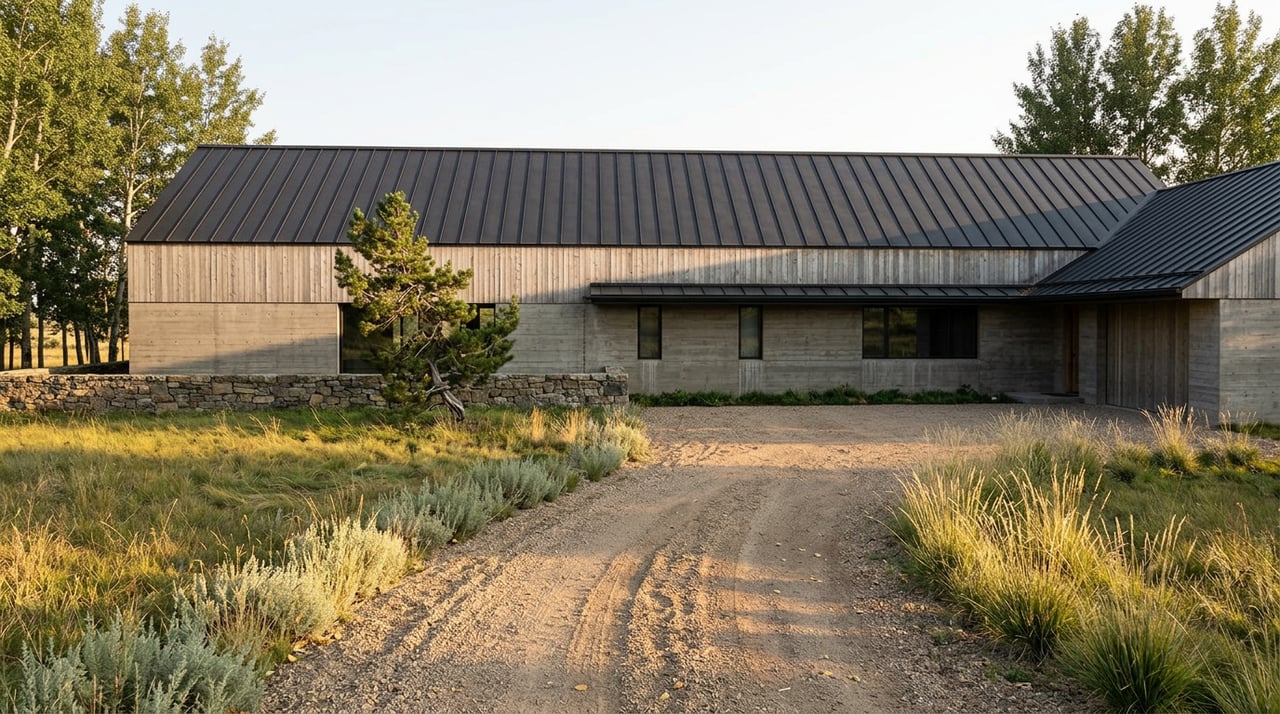
In May 2025, two adjacent parcels on McLain Flats Road sold together for $41 million. Neither had a house on it. The sale offers a useful starting point for understanding how county approvals and development rights can shape a parcel's value.
That transaction is the clearest window into how McLain Flats actually works. The mountain views, the White Star Ranch and Star Mesa subdivisions, the wide-open plateau above the Roaring Fork River, all of that is real and all of it matters. But none of it tells you how big a house you're allowed to build. That answer lives in a separate, thinly traded market that most buyers never hear about until they're deep into a purchase contract.
What Pitkin County Actually Limits
McLain Flats lots are subject to county-code floor-area limits, not limits set by acreage. The county's limits have changed over time.
Against the backdrop of changing county limits, one property on the McLain Flats corridor, an 11,880-square-foot house built in 2009, sold in December 2025 for $56.5 million.
The Currency Nobody Mentions at the Showing
The way around the cap, when it's available at all, runs through Pitkin County's Transferable Development Rights program. A TDR is a development credit generated by permanently giving up the right to build on one parcel, called the Sending Site, and applying that credit to a different parcel, the Receiver Site. The county's own program summary lays out the arithmetic plainly: land inside the Rural/Remote or TR-1 zone districts generates one TDR for every 35 acres, and each TDR unlocks 2,500 additional square feet of floor area on a Receiver Site.
That single detail changes how a McLain Flats parcel should be evaluated. A ten-acre lot with no TDR attached is not the same asset as a ten-acre lot that comes with one already secured. The second lot is, in effect, selling two things: the land and a legal permission slip that the county issues sparingly.
What a TDR Has Actually Cost, Recently
TDR prices move independently of the broader Aspen market, and they have moved a great deal. During the post-pandemic buying frenzy of 2021 and 2022, certificate shortages pushed prices to a peak of roughly $2.0 million to $2.5 million each. By 2026, that same certificate was trading closer to $650,000 to $800,000, a correction of more than half from the top.
| Period | Approximate price per TDR certificate |
|---|---|
| 2021–2022 (post-pandemic peak) | $2.0M – $2.5M |
| 2026 (current inventory) | $650K – $800K |
Two things happened at once to produce that decline. The county tightened the rules further, shrinking the pool of buyers who need a 2,500-square-foot expansion in the first place, since fewer homes can qualify for a large addition under the county's revised limits. And the long-standing TDR inventory built up over roughly three decades of the program has slowly worked its way into the market, easing what had been a genuine shortage.
A Sale on McLain Flats
Built in 2009, the 11,880-square-foot McLain Flats home had previously sold for $19.5 million in September 2020.
The 2017 Fight That Set the Template
McLain Flats has watched this play out in public before. Aspen Daily News reported that in 2017, the owner of a 148-acre parcel that included the historic Stein Ranch sought approval for a three-home compound. County commissioners approved it on a 3-to-1 vote, but with a condition attached: each home was capped at 5,750 square feet above ground and 3,000 square feet below, with the larger size made possible only through the purchase of TDRs. The owner's attorneys had pushed for one home at 7,500 square feet and called the denial a deal breaker.
Pam Moore, a longtime McLain Flats resident, spoke against the project at the hearing, arguing that further development was pushing wildlife into worse and worse habitat. The commissioners approved the compound anyway, but the size limits and the TDR requirement stood. It is a small case study in how the county actually uses this tool: not to block development outright, but to set a price, in the form of a certificate, on how much larger than baseline a home is allowed to be.
What This Means If You're Evaluating McLain Flats Today
Acreage and view corridor are still the reasons people fall for McLain Flats. But if the size of the house matters to your plans, the questions worth asking shift.
- Does this parcel already have TDRs applied, and how many square feet do they unlock?
- What rules apply to an existing structure, if there is one?
- If TDRs aren't attached, what would sourcing them cost at today's price, roughly $650,000 to $800,000 each, and is that inventory even available?
- Is the property within the Aspen Urban Growth Boundary, or outside it?
None of these questions show up on a standard listing sheet. They surface in title work, in county planning files, and in conversations with a broker who has watched this specific mechanism move prices for years. On a market where the median transaction runs into eight figures, that is not a minor gap to close late in a negotiation.
A Question Worth Asking Before You Tour
Is the TDR program going away? County officials have at times floated the idea of phasing out new TDR issuance while continuing to honor certificates already in circulation. Public records don't show that question fully settled, so anyone counting on future TDR availability should treat it as an open question rather than a guarantee.
McLain Flats rewards buyers who ask what a parcel actually permits, not just what it overlooks. If you're weighing acreage against entitlement, or trying to read a McLain Flats listing the way the county itself will read it, Carrie Wells has spent decades tracking exactly this kind of detail across the Roaring Fork Valley. Work With Carrie Wells before you make an offer that assumes more house than the code will allow.
This article is general information, not legal, tax or financial advice. Consult a qualified professional about your situation.